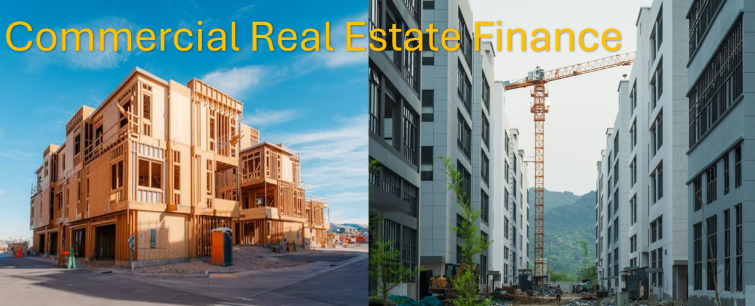
Commercial Real Estate Financing
Commercial Real Estate (CRE) is defined as property used exclusively for business or revenue-generating purposes. This broad category excludes properties for personal use, such as single-family homes or owner-occupied condominiums, and instead includes office buildings, retail centers, industrial warehouses, multifamily apartment complexes, housing development complexes, and hotels structured for commercial and business use.
CRE properties are typically purchased, leased, or built to generate steady rental income and long-term capital appreciation.
Financing for these properties ranges from $2 million to hundreds of millions of dollars, with loan structures shaped by a property's size, class (A, B, or C), appraised value, and short-, mid-, or long-term profit potential, among other factors. Because these properties are built for business and commercial revenue generation, they typically carry greater profit potential — often driven by the number of units or streams of revenue they create. This scale allows for a wide range of financing structures and lender types, including conduit and mortgage bankers, private and institutional lenders, banks, insurance companies, funds, REITs, and investors. Commercial real estate can be financed through several lending structures, depending on whether you're buying, building, refinancing, or stabilizing a property.
Key Types of Commercial Real Estate
Commercial real estate is typically categorized into four classes, based on function:
- Office space
- Industrial use
- Multifamily rental (generally more than 5 units)
- Housing development complexes (e.g., building multiple houses or buildings)
- Condominium buildings
- Retail
Individual categories may be further classified. For example, retail real estate includes several distinct types:
- Hotels and resorts
- Strip malls
- Restaurants
- Healthcare facilities
What GGA-Loans Offers
GGA has a dedicated team in this space to help clients secure the best financing solutions for their needs. Our team's 30+ years of experience, combined with a strong lender network, allows us to structure creative yet sound solutions flexible enough to fit each client's project, goals, and situation. Our toolbox offers far more than most lenders can provide alone — GGA-Loans delivers a wide array of loan and financing products with the ability to make it work for our clients' goals.
Standard Types of Commercial Real Estate Financing
Permanent Loans (Traditional CRE Mortgages)
These are long-term mortgage loans secured by income-producing property such as offices, retail centers, apartments, hotels, or industrial buildings. A commercial real estate loan is a mortgage secured by a lien on commercial — not residential — property.
General features:
- Loan terms: 5 to 20 years
- Often longer amortization (e.g., 25–30 years) with a final balloon payment
- Down payments typically 20% to 30%
- Interest rates generally higher than residential loans
Permanent/traditional loans are the most common strategy for this type of financing, as they are ideal for stabilized, income-generating properties.
SBA Loans (504 and 7(a))
Small Business Administration loans are popular for owner-occupied commercial properties. SBA loans:
- Are issued by lenders but partially guaranteed by the SBA
- Often offer lower rates than standard CRE loans
- Work well for small businesses purchasing their facilities
They tend to be more accessible for qualified small business borrowers compared to private-market CRE loans.
Bridge Loans
Bridge loans are short-term financing solutions, commonly structured for a six-month to three-year term. They are commonly used when:
- A borrower is waiting on permanent (traditional CRE mortgage) financing
- Repositioning or renovating a property
- Covering timing gaps in refinancing
Bridge loans usually carry higher rates due to their short duration and risk profile.
Construction Loans
Short-term loans — usually under one year, though often longer — that finance development or major improvements. They typically convert into permanent financing after completion. Construction loans:
- Carry higher interest rates due to development risk
- Fund projects before income generation begins
Floor Loans
A floor loan is a specific type of loan designed for real estate construction projects, providing the initial funding portion for tenant-occupied commercial developments.
Key structure:
- The lender advances an initial portion
- Remaining "holdback" funds are released as the borrower achieves specified milestones (construction phase, completion, leasing, occupancy permits, etc.)
- Builders may need bridge or mezzanine financing if milestones are delayed
Floor loans are limited to commercial developments, not owner-occupied residential properties.
Mezzanine & Subordinate Financing
Used to supplement senior loans when borrowers need additional capital.
Subordinate financing:
- Ranks below senior debt in repayment priority
- Carries higher interest rates due to higher risk
- Includes subordinated bonds, asset-backed securities, and mezzanine debt
Mezzanine financing:
- Is often structured as hybrid debt/equity
- Can include warrants or equity components
- Is frequently used in commercial property capital stacks
This is especially common in large acquisitions and development projects.
Project Finance (SPV-Based Structure)
Large, infrastructure-like real estate developments may use project finance — funding for long-term infrastructure, industrial projects, and public services. This structure typically:
- Uses a Special Purpose Vehicle (SPV)
- Relies on project cash flows for repayment
- Is structured as non-recourse or limited-recourse
This approach keeps debt off the sponsor's primary balance sheet.
CRE Structured Securities (CDOs & CMBS Exposure)
In capital markets, commercial real estate loans may be packaged into structured products. Commercial real estate CDOs:
- Are backed by commercial mortgage assets
- Provide investor exposure to CRE debt markets
These are investment-side financing structures rather than direct borrower loans, but can be used for CRE funding.
GGA has a dedicated team in this space to help provide financing solutions that work for our clients' success. Let Greater Globe Alliance, GGA-Loans — with a toolbox very few can match and a bona-fide lender network — be your financing partner.
Benefit from our extensive knowledge, decades of experience and resources to help your business reach its next level of success.